




- Your cart is empty Browse Shop

A2 Cow Ghee vs. Regular Ghee: Why Your Body Needs the Difference.
The defining difference between A2 cow ghee and regular ghee comes down to a single protein structure and how your digestive system reacts to it. While regular ghee is a staple for cooking, A2 ghee—made strictly from the milk of indigenous cow breeds like Gir or Sahiwal—is increasingly viewed as a functional food that actively supports gut health, immunity, and cellular repair.
The Science: Why the Body Prefers A2
The core difference lies in the beta-casein protein found in the milk used to make the ghee.
Modern crossbred cows produce a mix of A1 and A2 proteins. When your body digests A1 protein, it releases a peptide called BCM-7 (Beta-Casomorphin 7). For many people, BCM-7 acts as an inflammatory trigger, causing bloating, sluggish digestion, and heaviness.
Indigenous cows produce milk containing only the A2 protein. Because the A2 protein breaks down smoothly without releasing BCM-7, the resulting ghee is remarkably gentle on the stomach and does not trigger dairy-related inflammation.
A2 vs. Regular Ghee
Beyond the protein structure, the traditional preparation of A2 ghee (often the hand-churned Bilona method) concentrates its nutrient profile far more than industrial cream-separation methods used for regular ghee.
| Feature | A2 Cow Ghee | Regular Commercial Ghee |
| Protein Structure | 100% A2 Beta-Casein | Mix of A1 and A2 Beta-Casein |
| Digestion | Easily absorbed; no inflammatory BCM-7 | Can cause bloating or heaviness in sensitive individuals |
| Nutrient Density | High in fat-soluble vitamins (A, D, E, K2) | Lower concentration of bio-available vitamins |
| Fatty Acids | Rich in Butyric Acid and Omega-3s | Standard saturated fat profile |
| Preparation | Often made via the traditional Bilona (curd-churned) method | Usually mass-produced directly from milk cream |
The Traditional Wellness Perspective
In traditional practices, A2 ghee is highly revered and considered far superior to standard ghee for therapeutic use. It is viewed as “Liquid Gold” because of how it interacts with the body’s systems:
- Kindling Agni (Digestive Fire): The high concentration of butyric acid in A2 ghee fuels the cells lining the colon, naturally stimulating digestion and improving the absorption of nutrients from other foods.
- Building Ojas (Vitality): It is considered a premier food for building systemic immunity and resilience at a cellular level.
- Balancing Doshas: While regular oils can aggravate certain body types, A2 ghee has a unique grounding and cooling effect that helps balance Vata (dryness/joint pain) and Pitta (heat/inflammation) simultaneously.
- Medhya Rasayana (Brain Tonic): Rich in DHA and Omega-3s, A2 ghee is used as a cognitive enhancer to support memory, focus, and the nervous system.
For everyday cooking, regular ghee is still a healthy fat source. However, if you are using ghee for health optimization, morning rituals, or if you have any sensitivity to dairy, A2 ghee provides a distinct biological advantage.
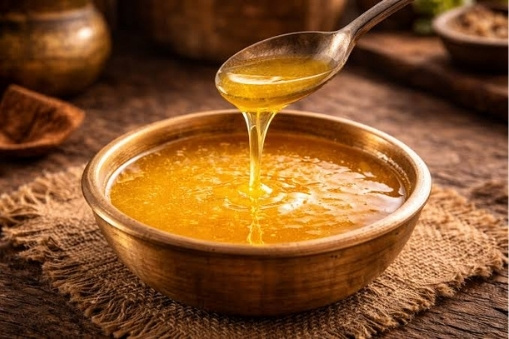
“Not all gold is mined; some is churned. While regular ghee simply feeds the body, traditional A2 ghee—the true liquid gold—kindles the digestive fire, eases the gut, and builds vitality from within.”