





- Your cart is empty Browse Shop
[google-translator]

[atlasvoice]
Funaba vs. Traditional Workouts: Why Agility is Key to Longevity
Welcome to the Sram India Ayush wellness journal. As the founder of a brand deeply rooted in the ancient wisdom of India, I have spent years observing how modern society approaches health. We live in an era obsessed with aesthetics. Millions of people spend hours every week lifting heavy weights in gymnasiums, running mindlessly on treadmills, and isolating specific muscle groups to build a physique that looks healthy in a mirror.
But what happens when you ask that same highly muscular body to twist suddenly to catch a falling object? What happens when it needs to spring up from the floor effortlessly, or dodge an unexpected obstacle? Often, the result is a pulled muscle, a torn ligament, or a stiff, rigid response.
Looking fit and being functionally, dynamically fit are two completely different things.
At Sram India Ayush, our mission is to nurture both inner wellness and outer vitality through 100% natural Ayurvedic products and holistic physical training. Today, we are diving deep into a fitness revolution that is quietly taking the wellness world—and Bollywood—by storm: the ancient Northeast Indian martial art of Funaba.
In this comprehensive guide, we will explore the great debate of Funaba vs. traditional workouts, unpack the science of why cultivating agility is the true secret to longevity, and show you how integrating this practice with Ayurveda and Yoga can completely transform your life.
Part 1: The Trap of Traditional Workouts
To understand the brilliance of Funaba, we first need to critically examine the modern, traditional workout paradigm.
The Linear Illusion
Most traditional gym workouts—think bench presses, bicep curls, leg presses, and even standard jogging—operate on linear planes of motion. You are moving weight up and down, or pushing your body forward in a straight line. While this is excellent for inducing muscle hypertrophy (muscle growth) and improving basic cardiovascular endurance, it is fundamentally flawed when it comes to preparing the body for the realities of life.
Life is not linear. Life happens in 360 degrees. You twist, you reach, you duck, you pivot. When you only train your muscles to operate in isolation on a single plane, you neglect the connective tissues, the stabilizing muscles, and the neurological pathways required for dynamic, multi-directional movement.
The Problem with Muscle Isolation
Gym machines are designed to isolate muscles. You sit down, strap in, and work your quadriceps without engaging your core or your upper body. Over time, this creates muscular imbalances. Your prime movers (the big muscles) become incredibly strong, while your stabilizers remain weak.
In Ayurvedic terms, this hyper-focus on building dense, rigid muscle mass can lead to an excess of Kapha (earth/heaviness) in the physical structure, leading to stagnation and stiffness, or an excess of Pitta (fire) if the training is fueled by aggression and ego, leading to inflammation and joint burnout.
Aging and the Loss of Functional Independence
As we age, it is not the lack of a 300-pound deadlift that forces us into nursing homes; it is the loss of balance, coordination, and agility. The leading cause of fatal and non-fatal injuries among older adults is falling. Traditional workouts do very little to train the body’s spatial awareness (proprioception) or reaction time. If you want to live a long, vibrant life where you can play with your grandchildren, hike mountains, and move without pain, you must train for agility.
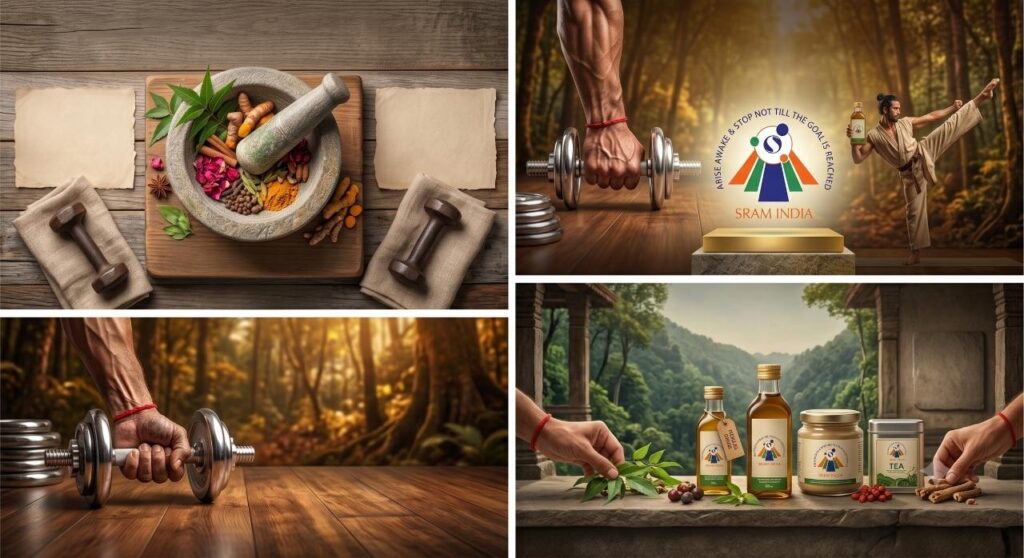
Unveiling Funaba – The Art of Dynamic Agility
Originating from the lush, spiritually rich landscapes of Northeast India, Funaba is an ancient martial art that has been preserved by warriors and sages for centuries. Unlike martial arts that focus purely on brute force or aggressive combat, Funaba is a fluid, rhythmic, and deeply spiritual practice.
What is Funaba?
At its core, Funaba is the physical expression of flowing energy. It mimics the movements found in nature—the strike of a serpent, the grace of a leaping leopard, the rooting of a great tree, and the swirling of river water.
It involves a complex series of strikes, blocks, leaps, and evasions that require the practitioner to use their entire body as a single, cohesive unit. In Funaba, there are no isolated movements. A punch does not just come from the shoulder; it originates in the feet, travels up the legs, twists through the hips and core, and explodes through the fist.
The Bollywood Connection
In recent years, Funaba has become a highly sought-after training method among Bollywood’s elite. Why? Because the modern actor needs more than just a bulky physique; they need absolute control over their bodies. They need to perform complex choreography, execute stunt work without injury, and maintain a lean, functional, and deeply agile physique. Funaba provides this by stripping away bulky rigidity and replacing it with panther-like grace.
Funaba vs. Traditional Workouts – The Core Differences
Let’s break down the comparative anatomy of these two approaches to fitness to understand why cultivating agility is so crucial.
1. Integration vs. Isolation
- Traditional Workouts: Focus on individual muscles (e.g., “Today is chest and triceps day”). The brain learns to fire muscles independently.
- Funaba: Every movement is a full-body event. The brain is forced to coordinate the legs, core, back, and arms simultaneously. This builds incredible neuro-muscular efficiency.
2. Multi-Planar Movement vs. Linear Movement
- Traditional Workouts: Mostly sagittal plane (forward and backward, like running or squatting).
- Funaba: Moves through all three planes of motion—sagittal, frontal (side to side), and transverse (rotational). This mimics real-world physics and bulletproofs the joints against injury.
3. Fascial Elasticity vs. Muscular Density
- Traditional Workouts: Focus on breaking down and rebuilding muscle tissue to make it thicker. This can lead to tight, shortened muscles if not properly stretched.
- Funaba: Trains the fascia—the connective tissue that wraps around every muscle and organ. By incorporating rhythmic bouncing, lunging, and twisting, Funaba keeps the fascia highly elastic and hydrated. This is the biological secret to moving like a youth well into your golden years.
4. Cognitive Engagement vs. Mindless Repetition
- Traditional Workouts: You can put on headphones, zone out, and do 3 sets of 10 on a leg press machine without thinking.
- Funaba: Requires intense mindfulness. You must constantly adapt to incoming strikes (even in shadow practice), memorize complex forms, and maintain balance. This builds neuroplasticity in the brain, staving off cognitive decline.
Why Cultivating Agility is the Key to Longevity
Longevity is not merely about extending the number of years you are alive; it is about extending your healthspan—the years you spend living disease-free, pain-free, and independently. Here is why agility, as cultivated through Funaba, is the ultimate longevity tool.
Preventing the Deadly Fall
As mentioned earlier, falls are a primary threat to longevity. Agility is the combination of balance, speed, strength, and coordination. When a Funaba practitioner trips on an uneven sidewalk, their highly trained nervous system reacts in milliseconds. Their core engages, their foot automatically steps out to widen their base of support, and they recover their center of gravity before they hit the ground. A person who only lifts weights linearly does not have this ingrained reflexive software.
Cardiovascular Efficiency Through Flow
Agility training is highly metabolic. A 45-minute Funaba session, transitioning seamlessly between low stances, high kicks, and rapid evasions, keeps the heart rate elevated in the fat-burning and cardiovascular-conditioning zones. It improves VO2 max and heart health without the joint-pounding impact of long-distance running on pavement.
Joint Lubrication and Bone Density
Agility requires moving joints through their full range of motion under dynamic tension. This stimulates the production of synovial fluid, which naturally lubricates the joints and prevents the onset of osteoarthritis. Furthermore, the multi-directional impact of martial arts stances and footwork tells the bones to lay down new tissue in various directions, increasing overall bone density.
The Sram India Ayush Synergy: Ayurveda, Yoga, and Funaba
At Sram India Ayush, we do not believe in practicing martial arts in a vacuum. True holistic health requires a trifecta: the dynamic energy of Funaba, the balancing stillness of Yoga, and the nourishing power of 100% natural Ayurveda.
Yoga: The Yin to Funaba’s Yang
If Funaba is the expression of outer vitality and kinetic energy, Yoga is the cultivation of inner wellness and stillness. A warrior who is fast and agile must also have a mind that is calm and centered.
- Flexibility for High Kicks: Yoga asanas deeply stretch the hamstrings, hips, and shoulders, allowing for the explosive movements of Funaba without tearing muscles.
- Breath Control (Pranayama): Yoga teaches us how to control Prana (life force) through the breath. A Funaba practitioner uses this breath control to maintain stamina during intense martial sequences.
“We do not stop playing because we grow old; we grow old because we stop playing. Funaba is the play of the warrior—dynamic, joyful, and eternal.” — Sram India Ayush
Ayurveda: Fueling the Agile Warrior
You cannot build an agile, long-lasting body on processed foods and synthetic supplements. To cultivate true longevity, your internal chemistry must support your physical efforts.
- Balancing the Doshas in Fitness: Funaba is an excellent way to move stagnant Kapha (lethargy and weight gain). However, intense physical exertion can aggravate Vata (air/space, leading to joint cracking and nervous system exhaustion) and Pitta (fire, leading to inflammation).
- Our 100% Natural Formulations: This is where Sram India Ayush steps in. We provide Ayurvedic support specifically designed for the modern warrior:
- Ashwagandha: Taken post-workout, this powerful adaptogen lowers cortisol levels, calms the nervous system (pacifying Vata), and accelerates muscle recovery.
- Turmeric & Shallaki (Boswellia): The ultimate natural anti-inflammatories. They cool the Pitta fire in the joints after an intense Funaba session, ensuring you wake up agile, not aching.
- Brahmi: To support the intense cognitive focus and neuroplasticity required to learn complex martial arts forms.
- Mahanarayan Oil: A traditional Ayurvedic massage oil. Applying this warm oil to the joints before or after training lubricates the tissues, promoting that vital fascial elasticity.
When you fuel your body with earth-derived medicine, train it with the agility of Funaba, and center your mind with Yoga, you create an unbreakable system of longevity.
Conclusion: Embrace the Way of the Agile Warrior
The debate of Funaba vs. traditional workouts is not about saying gymnasiums are entirely useless. It is about waking up to the reality that if we want to live long, pain-free, capable lives, we must train our bodies the way they were designed to move. We must abandon the pursuit of purely aesthetic, rigid muscle mass, and embrace the pursuit of agility, adaptability, and flow.
At Sram India Ayush, we invite you to step off the linear treadmill of modern fitness and reconnect with ancient wisdom. Discover the Northeast Indian martial art of Funaba. Nourish your recovering muscles with our 100% natural Ayurvedic formulations. Breathe life into your practice through Yoga.
Longevity is not a medical procedure; it is a lifestyle. It is time to cultivate agility. It is time to nurture your inner wellness and unleash your outer vitality. Join the Sram India Ayush community today, and let us walk this holistic path together.
 Our FAQs
 Frequently Asked Questions About Us
1. I have never done martial arts before. Am I too old to start Funaba?
Absolutely not. One of the greatest benefits of Funaba is its adaptability. Because it is rooted in fluid, natural movements rather than rigid, high-impact clashes, it can be tailored to any age and fitness level. Starting Funaba later in life is actually one of the best ways to improve neuroplasticity and prevent age-related balance issues.
2. Can I build muscle doing Funaba, or do I still need to lift weights?
Funaba builds incredibly dense, functional muscle, often referred to as “wirey strength.” You will develop a lean, highly defined physique (much like the Bollywood actors who practice it). While you may not build the bulky mass of a bodybuilder, you will build functional strength that far exceeds what you can achieve on a weight machine.
3. How does Ayurveda support injury prevention in martial arts?
Ayurveda focuses on keeping the bodily tissues (Dhatus) nourished and the joints lubricated. By consuming anti-inflammatory herbs like Turmeric, using traditional herbal massage oils (Abhyanga), and eating a diet appropriate for your Dosha, you keep your fascia elastic and your joints protected, drastically reducing the risk of tears or sprains.
4. Why is Funaba considered a "Northeast Indian" martial art?
India has a rich, diverse history of martial arts (Kalaripayattu in the South, Gatka in the North). Funaba traces its specific lineage to the northeastern regions of India, drawing inspiration from the unique topography, tribal warrior traditions, and deep spiritual connection to nature found in that specific area.
5. Are Sram India Ayush products genuinely 100% natural?
Yes. As the founder, my strictest mandate is that every product we offer is 100% natural, ethically sourced, and free from synthetic binders, fillers, or artificial chemicals. We rely entirely on the ancient texts of Ayurveda to formulate our health solutions.
6. Do I need special equipment to practice Funaba?
No! The beauty of Funaba is that your body is your gym. You do not need expensive machines or heavy weights. You only need a small amount of open space, a willing mind, and the desire to move naturally.