





- Your cart is empty Browse Shop
[google-translator]
[atlasvoice]
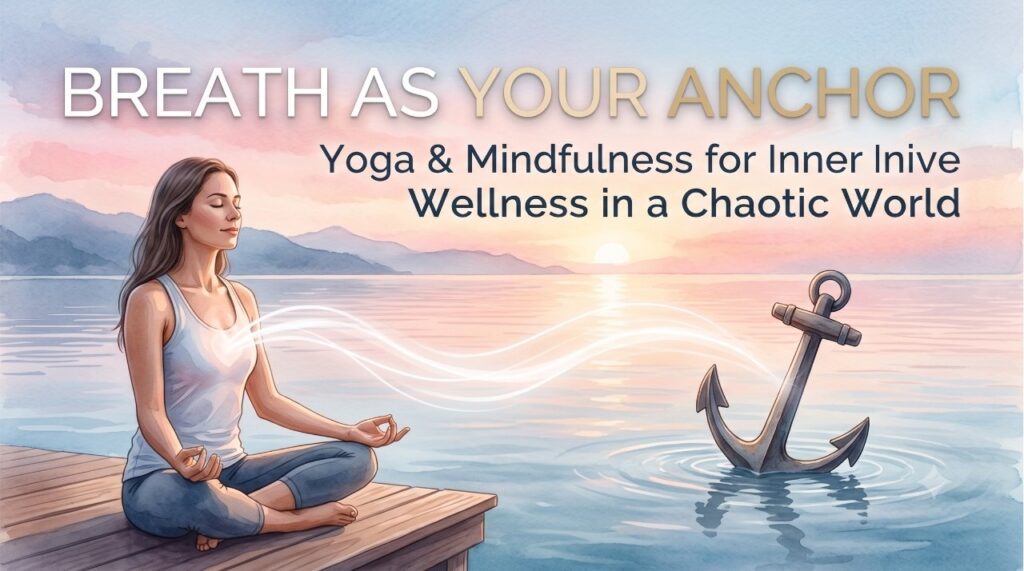
“Breath as Your Anchor: Using Yoga to Cultivate Inner Wellness in a Chaotic World”
Imagine a ship caught in the middle of a violent, swirling tempest. The wind is howling, the waves are crashing over the deck, and the vessel is being tossed violently from side to side. Without something to hold it in place, the ship would be entirely at the mercy of the storm, easily capsized or thrown against the rocks. But when the captain drops the heavy iron anchor into the depths, plunging it into the quiet, undisturbed ocean floor below, the ship stabilizes. It still feels the storm, but it is no longer washed away by it.
In our modern, fast-paced society, your mind is that ship, the relentless stressors of daily life are the storm, and your breath is your anchor.
Finding inner wellness in a chaotic world can often feel like an impossible pursuit. We are constantly bombarded by digital notifications, breaking news, career demands, and personal obligations. It is easy to become disconnected from ourselves, drifting into states of chronic anxiety and burnout. However, ancient traditions and modern science agree on one profound truth: the key to cultivating lasting peace lies quite literally right under our noses.
In this comprehensive guide, we will explore the philosophy of using your breath as your anchor, the physiological science behind why yoga and breathwork (pranayama) are so deeply effective, and how you can integrate these transformative practices into your daily life to cultivate an unshakable sense of inner wellness.
The Modern Epidemic of Chaos: Why We Need an Anchor
Before we can understand the cure, we must first understand the condition. We are living in an era of unprecedented noise. From the moment we wake up and check our smartphones to the moment we fall asleep (often while staring at a screen), our nervous systems are under constant siege.
The “Fight or Flight” Trap
Evolutionarily, our bodies were designed to handle acute, short-term stress. If a saber-toothed tiger chased our ancestors, their sympathetic nervous system would activate the “fight or flight” response. Adrenaline and cortisol would flood their system, their heart rate would spike, and their breathing would become rapid and shallow to supply immediate oxygen to their muscles for survival. Once the danger passed, the body would return to homeostasis.
Today, the “tiger” is an angry email from your boss, a traffic jam, a looming deadline, or the endless scroll of negative news on social media. Our brains perceive these psychological stressors as physical threats. Because these modern stressors never truly disappear, we remain stuck in a low-grade, continuous state of “fight or flight.”
The symptoms of this chronic chaos include:
- Physical: Shallow breathing, chest tightness, tension headaches, digestive issues, and chronic fatigue.
- Mental: Brain fog, racing thoughts, inability to concentrate, and memory issues.
- Emotional: Irritability, anxiety, depressive symptoms, and emotional reactivity.
To combat this, we cannot simply turn off the world. The chaos is a fixture of modern existence. Instead, we must learn to change our reaction to the world. We must learn to drop our anchor.
What Does “Breath as Your Anchor” Truly Mean?
In mindfulness and yoga traditions, the breath is revered not just as a biological necessity, but as a bridge between the body and the mind, the conscious and the subconscious.
When we say “breath as your anchor,” we are referring to the practice of returning your attention to the physical sensation of breathing whenever you feel your mind wandering into the past (which causes regret) or projecting into the future (which causes anxiety).
The Omnipresence of the Breath
Why the breath? Why not use a sound, an image, or a physical object as an anchor?
It is always with you: You don’t need an app, a special room, or a piece of equipment to breathe. Whether you are in a tense board meeting, sitting in traffic, or lying in bed at 3 AM, your breath is there.
It happens strictly in the present moment: You cannot breathe in the past, and you cannot breathe in the future. You can only breathe right now. Therefore, focusing on your breath instantly forces your mind into the present moment.
It is a mirror of your mental state: When you are angry, your breath is short and forceful. When you are asleep, it is deep and rhythmic. When you are anxious, it is shallow and erratic. By consciously altering your breath, you can reverse-engineer your mental state.
Using your breath as your anchor means utilizing this built-in tool to tether your wandering, anxious mind to the safety and stability of the present moment.
The Science: How Yoga and Breathwork Cultivate Inner Wellness
It is easy to dismiss yoga and mindful breathing as mystical or “woo-woo,” but modern neuroscience and biology have validated what yogis have known for thousands of years. Cultivating inner wellness through the breath is a hard biological science.
The Vagus Nerve and the Parasympathetic Nervous System
At the core of the mind-body connection is the vagus nerve, the longest cranial nerve in the body, which runs from the brainstem down into the belly, touching the heart, lungs, and digestive organs along the way. The vagus nerve is the command center for your parasympathetic nervous system, also known as the “rest and digest” state.
When you are stressed and taking shallow, rapid breaths from your chest, the sympathetic nervous system is in charge. However, when you intentionally slow your breathing—specifically by extending your exhalations and breathing deeply into your diaphragm—you stimulate the vagus nerve.
Stimulating the vagus nerve sends a powerful, instantaneous signal to your brain: “The environment is safe. You can power down.”
The Biological Benefits of Conscious Breathing
When you use your breath as your anchor through yoga and pranayama, a cascade of physiological changes occurs:
- Cortisol Reduction: The body’s primary stress hormone, cortisol, drops significantly.
- Heart Rate Variability (HRV) Increases: High HRV is a major indicator of physical and emotional resilience.
- Blood Pressure Lowers: The blood vessels dilate, reducing the strain on your cardiovascular system.
- Brain Waves Shift: Your brain shifts from high-frequency Beta waves (alert, anxious) to Alpha waves (relaxed, focused) and even Theta waves (deep meditation). “Breath is the king of mind.” — B.K.S. Iyengar
Key Yoga Practices to Cultivate Inner Peace
To build a sanctuary of inner wellness, you need actionable tools. In the yogic tradition, this is achieved through a combination of Pranayama (breath control) and Asana (physical postures). Here are detailed, highly effective practices you can use to anchor yourself against the chaos.
1. Transformative Pranayama (Breathing Techniques)
These techniques can be practiced anywhere—at your desk, in your car, or on your yoga mat.
Sama Vritti (Box Breathing)
Often used by Navy SEALs to maintain calm in high-stress combat situations, Sama Vritti translates to “equal fluctuations.” It balances the nervous system and clears the mind.
How to do it:
Inhale deeply through your nose for a count of 4.
Hold your breath at the top for a count of 4.
Exhale slowly through your mouth or nose for a count of 4.
Hold your breath at the bottom (lungs empty) for a count of 4.
Repeat for 5-10 cycles.
Why Cultivating Agility is the Key to Longevity
Longevity is not merely about extending the number of years you are alive; it is about extending your healthspan—the years you spend living
Nadi Shodhana (Alternate Nostril Breathing)
This ancient practice is believed to balance the left and right hemispheres of the brain, promoting a deep sense of equilibrium and lowering heart rate instantly.
How to do it:
- Sit comfortably. Bring your right hand up to your face.
- Rest your pointer and middle fingers between your eyebrows.
- Close your right nostril with your right thumb and inhale slowly through your left nostril.
- Close your left nostril with your ring finger (both nostrils are now closed) and hold briefly.
- Open your right nostril and exhale completely.
- Inhale through the right nostril, close it, and exhale through the left. This is one cycle. Repeat for 5 minutes.
Ujjayi Pranayama (Ocean Breath or Victorious Breath)
This is the foundational breath used during the physical practice of yoga. It creates a soothing sound that gives your mind a distinct auditory anchor.
How to do it:
Inhale deeply through your nose.
As you exhale through your nose, gently constrict the back of your throat as if you were trying to fog up a mirror with your mouth closed.
The breath should make an audible, textured sound, resembling ocean waves crashing on the shore.
“Yoga is not about touching your toes, it is what you learn on the way down.” — Jigar Gor
2. Grounding Asanas (Physical Postures)
While breath is the ultimate anchor, the body is the vessel. Holding physical tension prevents the mind from relaxing. These grounding yoga poses help release trapped physical stress, making it easier to breathe deeply.
Balasana (Child’s Pose)
Child’s pose is the ultimate posture of surrender and safety. It gently stretches the hips and lower back, areas where we famously store physical tension and emotional trauma.
- The Practice: Kneel on the floor, bring your big toes together, and widen your knees. Exhale and lay your torso down between your thighs. Stretch your arms forward or rest them alongside your body. Rest your forehead on the earth. Breathe deeply into the back of your ribcage, feeling it expand like a balloon. Stay here for 10-15 long breaths.
Vrikshasana (Tree Pose)
Balancing poses require you to be completely present. If your mind is chaotic, you will fall over. Tree pose forces you to drop your anchor.
- The Practice: Stand tall. Shift your weight onto your left leg. Place the sole of your right foot against your left inner thigh or calf (avoid the knee). Bring your hands to your heart center. Find a focal point (Drishti) and lock your eyes onto it. Use your Ujjayi breath to maintain your balance. Hold for 5-8 breaths, then switch sides.
Supta Baddha Konasana (Reclining Bound Angle Pose)
This deeply restorative pose opens the chest, allowing for maximum lung capacity, and opens the hips.
- The Practice: Lie flat on your back. Bend your knees and bring the soles of your feet together, letting your knees fall open to the sides like a book. Place one hand on your heart and one hand on your belly. Feel the rise and fall of your breath beneath your hands.
Integrating the Practice: Making the Anchor a Habit
Understanding the concept of using your breath as your anchor is only the first step; true inner wellness comes from consistent integration. You do not need to sit in an ashram for two hours a day to see the benefits of yoga and breathwork. The magic lies in consistency and “micro-dosing” mindfulness throughout your chaotic day.
Habit Stacking
Habit stacking is the process of attaching a new habit (mindful breathing) to an existing habit.
- Morning Coffee: While your coffee is brewing, do not look at your phone. Stand in the kitchen and practice 2 minutes of Box Breathing.
- The Commute: When you are stopped at a red light, instead of feeling impatient, use it as a trigger to take three deep Ujjayi breaths.
- Email Send: Before you hit “send” on an important or stressful email, take one deep breath in, sigh it out, and then click.
- Desk Yoga for the Corporate Warrior
- If you are chained to a desk, chaos often manifests as neck pain, tight shoulders, and eye strain.
- Seated Cat-Cow: Sit on the edge of your chair. Inhale, arch your back, and look up to the ceiling (Cow). Exhale, round your spine, tuck your chin to your chest, and pull your belly in (Cat). Sync the movement perfectly with the rhythm of your breath.
- Shoulder Rolls with Breath: Inhale deeply while shrugging your shoulders all the way up to your ears. Exhale forcefully through the mouth while dropping them down. Repeat 5 times.
- The “Transition” Breath
- Our days are made of transitions: waking up to getting ready, commuting to working, working to family time, family time to sleep. Often, we carry the chaotic energy of one phase into the next. Use your breath to create a buffer. Before walking through your front door after a long day of work, sit in your car for 60 seconds. Close your eyes, place your hand on your belly, and take 10 deep breaths. You are dropping the anchor, leaving the chaos of the workday behind, and entering your home with a grounded, peaceful presence.
The Long-Term Benefits of an Anchored Life
When you consistently use yoga and your breath as your anchor, the results compound over time, fundamentally altering how you interact with the world.
Emotional Non-Reactivity: Instead of snapping at a loved one or panicking over a mistake, the breath creates a fraction of a second of space between the stimulus and your response. In that space lies your freedom to choose a calm reaction.
Enhanced Focus and Productivity: A scattered mind is an unproductive mind. By repeatedly training your brain to come back to the breath, you are exercising your focus muscle. You will find it easier to enter flow states and complete tasks without distraction.
Improved Sleep Architecture: Chronic stress destroys sleep quality. By practicing calming pranayama (like alternate nostril breathing) before bed, you signal to your body that it is safe to down-regulate, leading to deeper, more restorative REM sleep.
Resilience in Adversity: The chaos of the world will not stop. There will still be tragedies, difficult people, and unexpected hardships. But when you have a strong anchor, you know that you have a safe harbor within yourself that no external force can touch.
Conclusion
We cannot control the weather of the world. The winds of chaos will blow, the economies will shift, the emails will pour in, and life will continue its unpredictable dance. However, we have total control over our own vessel.
By embracing the philosophy of “breath as your anchor,” you are reclaiming your power. You are choosing to step off the hamster wheel of chronic stress and step into a space of profound inner wellness. Through the physical postures of yoga that release bodily tension, and the life-giving practices of pranayama that soothe the nervous system, you can build an unshakable core of peace.
The next time you feel the panic rising, the frustration boiling, or the anxiety spinning, remember that your anchor is always with you. Close your eyes. Inhale deeply. Exhale completely. You are right here. You are safe.
 Our FAQs
 Frequently Asked Questions About Us
Q1: I have never done yoga before. Can I still use these breathing techniques?
A: Absolutely! You do not need to be flexible or have any prior yoga experience to practice pranayama. Breathing techniques like Box Breathing or Alternate Nostril Breathing can be done by anyone, anywhere, regardless of physical ability.
Q2: How long does it take to feel the benefits of using my breath as an anchor?
A: The physiological benefits are almost instantaneous. Taking just three deep, slow breaths can immediately lower your heart rate and reduce cortisol. For long-term benefits like reduced chronic anxiety and emotional regulation, consistency is key. Aim for 5-10 minutes of dedicated practice a day, and you will likely see profound changes within a few weeks.
Q3: What should I do if my mind keeps wandering while trying to focus on my breath?
A: First, know that this is completely normal! The nature of the mind is to think. When you notice your mind has wandered to your grocery list or a work problem, do not judge yourself. Simply acknowledge the thought, and gently redirect your attention back to the sensation of the breath. The act of noticing and returning is the practice.
Q4: Is there a specific time of day that is best for breathwork and yoga?
A: The best time is the time that you can commit to consistently. Many people prefer the morning to set a calm tone for the day, while others prefer the evening to wash away the stress of work and prepare for sleep. You can also use breathwork “on demand” whenever you feel overwhelmed.
Q5: Why do we breathe through the nose during yoga rather than the mouth?
A: Nasal breathing acts as a natural filter, warming and humidifying the air before it reaches the lungs. More importantly, breathing through the nose releases nitric oxide, a molecule that helps widen blood vessels and improve oxygen circulation. It also naturally slows the breath down, which helps activate the parasympathetic nervous system much more effectively than mouth breathing.